Santaraksita

Santaraksita was an Indian Buddhist abbot of Nalanda University. He was very popular during the 8th century. It is recorded that he founded the philosophical approach known as Yogacara-Madhyamika. This philosophical approach is the result of the unification of the Madhyamaka tradition of Nagarjuna, the Yogacare tradition of Asanga, and the logical and epistemological thought of Dharmakirti.
It has also been recorded that Santaraksita was the influential person who introduced Buddhism and also Sarvastivadin monastic ordination lineage to Tibet. His thoughts and views were popular during the 8th century period. After that in the 15th century, Je Tsongkhapa's interpretation and philosophy regarding Prasangika Madhaymaka were recognized and was popularized. But in the 19th century, Ju Mipham promoted his views as a way to discuss specific critiques of Je Tsongkhapa's Interpretation.
Biography of Santaraksita
Santaraksita was born in Rewalsar, present day a state of Himachal Pradesh in India. He was the son of the king of Zahor. It was recorded that before the mid 8th century, Santaraksita was brought to Tibetan Empire at the instigation of Emperor Trisong Detsen. There, he oversaw the translation of a large body of scriptures into Tibetan and also supervise the construction of the first Buddhist monastery at Samye in the late 8th century. He helped to establish the first monastics. He stayed at Samye Monastery for the rest of his life and didn't return to India.
Later, he faces some of the challenges due to the antipathy of Bonpos and interference from the local spirits. Therefore he then thought that a teacher excelled in supernatural powers and mystic charms would be able to move deeply the people of Tibet. Hence, he suggested the King to invite the Buddhist teacher Padmasambhava with the objective to subdue the Tibetan devils and demigods.
Santaraksita's works
In early teachings in Tibet, he was more directed to teach the seven virtues that were tested rather than ten virtues and chain of causal relations. Apart from his teachings, his writing was also influential which disseminate his works. His texts Madhyamakalamkara, and Tattvasamgraha are well-known texts even in today's context.
Madhyamakalamkara
It is clear that Mahdyamakalamkara is the more elaborative text which unites the Madhyamaka, Yogacara, and Pramana. In the short verse text of Madhyamakalamkara,Santaraksita explains his two truths doctrine of philosophical syntheses of the conventional truth of the Yogacara philosophy, along with the ultimate truth of the Madhyamaka and with the assistance of Buddhist logic. For the readers, it is suggested that they are advised to adopt Madhayamaka view and approach from Nagarjuna and Aryadeva. This is mainly helpful when they analyze the text for ultimacy and to learn the views of Yogacarans Asanga and Vasubandhu. In the text, he also incorporates the logic approach of valid cognition as well as the Sautrantika views of Dignaga and Dharmakirti.
Tattvasamgraha
Another best-known text of Santaraksita is Tattvasamgraha. This text is viewed as an encyclopaedic treatment of the major philosophical views of the time which survived in translation in both Tibet and China. The Sanskrit version of the Tattvasamgraha was discovered by Dr. G. Buhler in the Jain temple of Parsva at Jaisalmer. It was also learned that the discovered text contained the commentary by Santaraksita's pupil Kamalasila.
Influence of Santaraksita's works during and after Rime Movement
It is already mentioned that Santaraksita's philosophic views were dominant in Tibet from the 8th century until 15th century. After this period Je Tsongkhapa's interpretation of Prasangika Madhyamaka was dominant. But in the late 19th century, Ju Mipham initiated Rime Movement as a way to discuss specific critiques of Je Tsongkhapa's interpretation of Prasangika. This Rime movement also revitalized the other traditions like the Sakya, Kagyu, Nyingma, and Jonang traditions which were suppressed by the Gelung traditions. One of the notable movement of this initiation was the commentary about Santaraksita's Madhyamakalankara by 19th century Nyingma scholar Jamgon Ju Mipham Gyatso. The commentary leads the Nyingma monastic to include the texts of Santaraksita and now this text is studied by all Nyingma Shedra students.
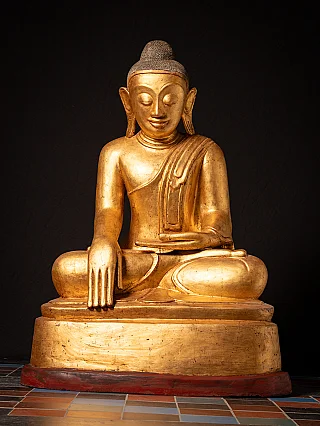
Note: FYI, we also manage and sale huge collection of various period and regional Buddhist arts and statues of Burmese Buddhas are one of them. Please feel free to visit our online Buddha statues gallery to know more about the Buddha statues.
Share this page